Best Air Pumps for Fish Tanks: Quiet, Efficient Aquarium Aeration
Choosing the right air pump for a fish tank ensures consistent oxygenation, stable water movement, and a peaceful aquarium environment. This guide highlights five reliable options designed for a range of tank sizes, noise levels, and energy use. Each selection includes dual outlets or adjustable flow to fit diverse aquariums, from small tanks to larger setups. Compare performance, noise, and durability to determine the best fit for your aquatic pets.
| Product | Brand | Tank Range |
|---|---|---|
| Uniclife 64 GPH Aquarium Air Pump | Uniclife | 10-100 gallons |
| Pawfly Aquarium Air Pump 50 GPH | Pawfly | 10-60 gallons |
| AQQA Aquarium Air Pump 18W | AQQA | Up to 600-1000 gallons (ponds/hydroponics) |
| AQQA Aquarium Air Pump 3W/6W | AQQA | Up to 200 gallons |
| AQUANEAT Aquarium Air Pump | AQUANEAT | Up to 100 gallons |
style=”margin-top:24px;”>Uniclife 64 GPH Aquarium Air Pump
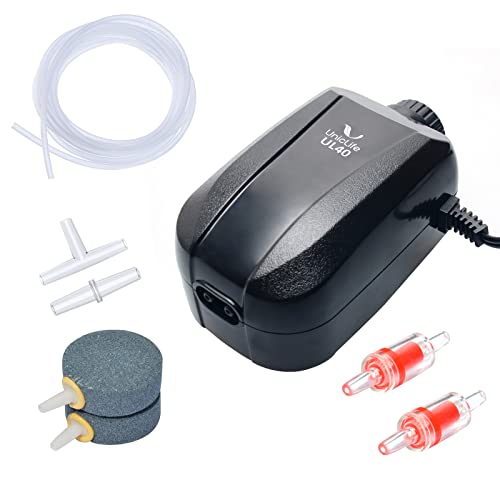
The Uniclife air pump offers a steady 64 GPH output with dual outlets to aerate multiple zones of a tank. It operates at 0.016 MPa pressure and uses 4 W of power, making it suitable for 10-100 gallon freshwater or marine setups. A rotary control adjusts air flow for each outlet, enabling tailored oxygenation. Noise varies by flow, with 25 dB in low mode and up to 45 dB at higher flow, which is comparable to a quiet household appliance. The included accessories support immediate setup and valve integration.
style=”margin-top:24px;”>Pawfly Aquarium Air Pump 50 GPH

The Pawfly air pump delivers 50 GPH with a compact footprint and a low power draw of 1.25 W. It is designed for tanks up to 60 gallons and features a top-mounted knob to adjust air flow. A rubber-based chassis minimizes vibration, keeping noise under 30 dB for quiet operation. With dual outlets and included tubing and connectors, it suits small to medium aquariums and bucket setups, offering reliable performance with energy efficiency.
style=”margin-top:24px;”>AQQA Aquarium Air Pump 18W / 12W

The AQQA 12W/18W model offers up to 237-356 GPH and high air pressure, making it suitable for large tanks, ponds, or hydroponics. It features a robust rubber base and copper-wire motor for durability and stable airflow, with an inline regulator per outlet to fine-tune output. The unit emphasizes energy efficiency and long service life, supporting multi-tank setups with reliable aeration across outlets.
style=”margin-top:24px;”>AQQA Aquarium Air Pump 3W / 6W

This quieter, stainless steel dual-outlet air pump delivers 3W or 6W configurations with a maximum of 100 GPH and max pressure around 18 KPa. The design emphasizes low noise (under 35 dB) and a longer service life due to a double-layer structure and rubber pads. The two outlets enable independent oxygenation for multiple zones, suitable for larger tanks or multi-section aquariums.
style=”margin-top:24px;”>AQUANEAT Aquarium Air Pump

The AQUANEAT air pump is designed for up to 100 gallons and features dual outlets with compatible stones, tubing, and check valves. Its quiet operation is supported by stabilizing feet that minimize vibration, helping to maintain a calm aquarium environment. This unit is well-suited for hobbyists seeking straightforward installation with reliable aeration across multiple outlets.
style=”margin-top:24px;”>Buying Guide: Key Purchase Considerations
- Tank size and aeration needs: Match pump flow (GPH) and pressure to your aquarium volume and stocking level. Larger tanks benefit from higher GPH or multiple outlets.
- Noise and vibration: Look for models with rubber feet, solid housings, and low dB ratings if the tank is in a living space or bedroom.
- Outlets and configurability: Dual outlets allow independent control of aeration zones, sponge filters, or air stones. Check if each outlet has adjustable flow.
- Power efficiency and durability: Copper motors and robust casings improve longevity and reduce running costs over time.
- Accessories and installation: Included tubing, air stones, check valves, and connectors simplify setup and prevent backflow or leaks.
- Maintenance and parts availability: Availability of replacement diaphragms, valves, or membranes can extend pump life.
- Environment compatibility: Some models are suitable for marine, freshwater, or hydroponic applications; ensure compatibility with your setup.
- Maintenance routine: Regularly clean intake outlets and replace worn air stones to maintain oxygenation efficiency.