Best Heat Lights for Leopard Geckos
Leopard geckos rely on a steady heat gradient to support metabolism, digestion, and healthy shedding. A reliable heat light should create a warm basking spot without overexposing the enclosure to light at night. The right bulb also helps maintain safe temperatures while minimizing stress for your gecko. Below are five top heat-light options that balance effective heating with safety and ease of use for leopard geckos in American homes.
The table below offers a quick at-a-glance comparison of the chosen products. It highlights heat type, wattage, and typical day or night use to help you pick the best match for your terrarium setup.
| Product | Brand | Watt | Heat Type | Best For |
|---|---|---|---|---|
| Fluker’s 75W Basking Spotlight Bulb | Fluker’s | 75W | Incandescent Basking | Daytime basking heat |
| MCLANZOO 75W Infrared Red Heat Lamp | MCLANZOO | 75W | Infrared | Night heat for leopard geckos |
| MCLANZOO 75W UVA Daylight 2 Pack | MCLANZOO | 75W | UV-A Daylight | Daytime heat and activity |
| CAVACHEW 50W G9 Reptile Kit | CAVACHEW | 50W | UVA Basking | Compact enclosures, beaded geckos |
| ReptiKing 75W Intense & Infrared Basking Bulbs | ReptiKing | 75W | Infrared & Intense Basking | Versatile 24-hour cycle |
Fluker’s 75W Basking Spotlight Bulb

Fluker’s incandescent basking spotlight is designed to deliver targeted heat and light for reptile terrariums. The 75-watt bulb directs heat toward a defined basking area, helping leopard geckos reach and maintain their preferred body temperature. Its infrared output supports warmth without excessive illumination, making it a practical option for daytime basking and robust metabolic support. Use caution with proximity to the gecko to prevent overheating, and ensure a secure lamp holder and reflector to maximize heat distribution.
- Directed heat and light for basking
- Infrared emission to support warmth
- Designed to help regulate core body temperature
MCLANZOO 75W Infrared Red Heat Lamp
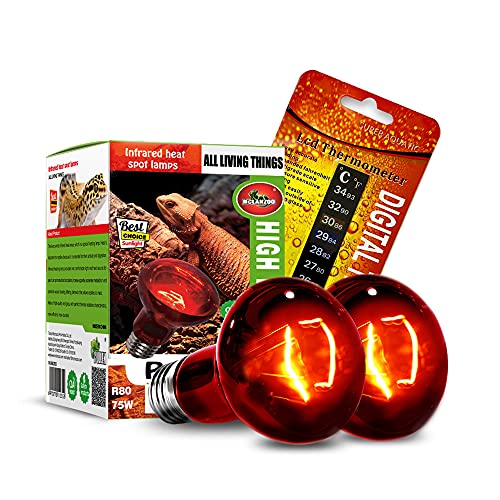
This infrared heat lamp uses red infrared waves to raise enclosure temperatures while keeping light levels low at night. The 75-watt bulb is designed for extended service life and fits typical E26 sockets, making it a practical choice for leopard geckos requiring consistent warmth after lights-out. Its soft, non-dazzling glow helps minimize disturbance to natural activity cycles, especially when paired with a separate daytime light source.
- Infrared waves increase overall temperature
- Long service life with compatible E26 socket
- Soft, non-disturbing light for nocturnal cycles
MCLANZOO 75W UVA Daylight 2 Pack

This daylight-ready bulb provides UVA-enriched illumination to support daytime activity and appetite in leopard geckos. At 75 watts per bulb, it offers reliable heating while enabling natural behavioral patterns during the day. The two-pack format helps maintain a consistent day-night cycle across larger setups or multi-species vivariums. If your terrarium lacks a dedicated nighttime heat source, pair this with a separate infrared or night-heat option.
- Long-wave UVA warmth for daytime behavior
- Supportive heat to promote appetite and activity
- Two-pack for versatile setup options
CAVACHEW G9 Reptile Heat Lamp Kit

The CAVACHEW kit combines a 50-watt UVA basking bulb with a low-profile hood for convenient mounting above mesh or glass enclosures. The compact design helps maintain a warm basking zone without crowding space in smaller terrariums. The included safety mesh and warm white light provide dependable daytime heating while keeping a low profile, which is ideal for leopard gecko setups that prioritize compact habitats or corridor-style enclosures.
- 50W UVA basking bulb with a low-profile hood
- Tool-free installation above or below mesh
- Safety mesh included for enclosure protection
ReptiKing 75W Intense & Infrared Basking Bulbs

ReptiKing offers a pair of 75-watt bulbs designed for intense basking combined with infrared warmth. This setup supports thermoregulation by creating a distinct hot zone while enabling nighttime warmth with infrared to minimize light disruption. The bulbs are suitable for Leopard geckos in terrariums that require a stable day-night temperature gradient. They can be used alongside night heat or UVB sources as part of a comprehensive habitat plan.
- Intense basking with infrared warmth
- Pair included for versatile heat zones
- Supports 24-hour thermoregulation with compatible accessories
Buying Guide
When choosing heat lights for leopard geckos, consider how you will manage day and night temperatures, enclosure size, and heat distribution. The most effective setups combine a daytime heat source with an appropriate nighttime option, plus a way to regulate temperature safely.
- Heat source type: For daytime heat, incandescent basking bulbs and UVA daylight bulbs can provide both warmth and activity-promoting light. For nighttime warmth, infrared bulbs or red-spectrum bulbs deliver heat with minimal light disturbance.
- Wattage and distance: Leopard gecko enclosures vary in size. Higher wattage bulbs require careful placement to avoid overheating; use a reflector or hood to focus heat on the basking area and measure temperatures at the hot spot with a reliable thermometer.
- Temperature targets: Aim for a basking spot around the upper 80s to low 90s Fahrenheit, with cooler areas elsewhere in the enclosure. Regular temperature checks help maintain a safe gradient.
- Day/night cycles: Provide a clear day-night schedule. In many homes, geckos do not require light at night, so a dedicated infrared night heat source is ideal if night-time warmth is needed.”
“ - Safety and installation: Use sturdy fixtures, avoid water exposure, and consider a thermostat or dimming control to maintain stable temperatures. A guard or hood can protect geckos from direct contact with hot bulbs.
- Fixture compatibility: Ensure bulbs fit your existing fixtures (e.g., E26 sockets or G9 bases) and that mounting options accommodate your terrarium lid or wall setup.
- Longevity and maintenance: Some bulbs offer longer service life than others. Plan for bulb replacement on a schedule to keep heat output consistent and reliable.