Best Ultrasonic Bark Deterrents for a Quieter Home
Ultrasonic bark deterrents offer a humane way to reduce barking by emitting a sound that dogs hear but humans typically do not. When choosing a device, consider range, frequency options, training modes, and weather resistance to fit your home, yard, and lifestyle. The five picks below balance effectiveness with safety for a wide range of breeds and environments, from quiet apartments to spacious yards. Each model supports multiple training modes and adjustable settings, designed for indoor and outdoor use. Review the quick summary table and then dive into detailed sections for each model to help you decide which fits your needs.
| Product | Brand | Range (ft) | Notable Feature |
|---|---|---|---|
| YUYQA Ultrasonic Bark Deterrent | YUYQA | 23 | 3X emitters; 6 training modes |
| Cbersmg Bark Deterrent Device | Cbersmg | 50 | 3X emitters; 5 training modes |
| Cuukiee Bark Deterrent Devices | Cuukiee | 50 | 3 adjustable modes; IP65 weatherproof |
| SEDULAN Bark Deterrent Device | SEDULAN | 50 | Integrated LED flashlight; train with whistle & clicker |
| Phzibor Bark Deterrent Device | Phzibor | 65 | 3 frequencies; 5 modes; color display |
YUYQA Ultrasonic Bark Deterrent

The YUYQA bark deterrent uses three ultrasonic emitters to broaden coverage up to 23 feet, aiming to stop barking, jumping, and related misbehaviors with a humane approach. It supports six training options, combining fixed 25kHz and variable 20-30kHz frequencies, plus four ultrasonic modes, an audible beep, and an LED flashlight for low-light training. This setup targets dogs from about six months to eight years and emphasizes safety for most breeds, though it is not recommended for dogs with certain neurological conditions. Indoor and outdoor use are possible with direct aiming at the dog for best results.
For effective results, use directional aiming and short sessions. Pair the ultrasonic cues with firm verbal commands and praise when your dog responds correctly. Keep the device away from the eyes and ears of dogs and people, and avoid prolonged exposure in a single session. Regularly rotate modes to prevent habituation, and monitor your dog for signs of stress. The built-in flashlight aids nighttime training in backyards or dim spaces, enhancing safety during outside sessions.
Cbersmg 3X Ultrasonic Bark Deterrent
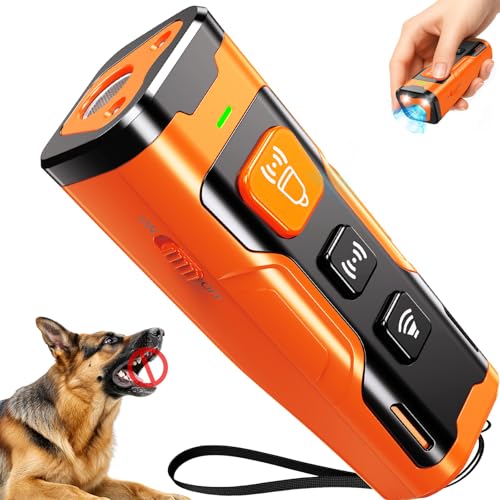
The Cbersmg model employs three ultrasonic emitters to provide rapid, humane bark suppression within a 50-foot range. It alternates between a fixed 25kHz frequency and a variable 22–29kHz range to help prevent dogs from tuning out the signal, delivering 3X coverage for quicker training responses. It offers five training modes designed to adapt to different dogs’ temperaments, without any physical contact or aversive devices. It is suitable for indoor and outdoor use, and includes a compact design with a flashlight feature for night training. As with all devices, avoid exposing dogs with known neurological issues to ultrasonic stimuli.
Use the device by directing it at the dog from a safe distance and pairing sessions with consistent verbal cues like “Stop” or “Quiet.” Short, positive sessions work best, followed by praise or a treat when the dog responds appropriately. Maintain a clear line of sight to the target dog, and avoid fixed training routines that could cause stress or fear. This model’s rugged build makes it a practical option for yards, fences, and near entryways where barking occurs most often.
Cuukiee 3-Mode Ultrasonic Bark Deterrent

The Cuukiee device features three adjustable modes and a strong 50-foot range, designed for flexible use in both indoor and outdoor settings. Its IP65 weatherproof shell supports rain, snow, and other weather conditions, allowing placement on fences, walls, or trees. The system is tuned to human-friendly ultrasonic frequencies, delivering a non-painful cue to discourage barking and other behaviors, such as digging. It targets a broad spectrum of dogs while preserving hearing health. For optimal outcomes, ensure a direct line of sight and minimize obstructions that could dampen the signal.
Practical deployment tips include pairing ultrasonic cues with calm, consistent commands and brief reward-based training. Place the device where barking is most prevalent—near gates, yards, or entryways—and rotate modes as needed to maintain effectiveness across different dogs and temperaments. Regular maintenance and battery checks help maintain performance, especially for outdoor installations exposed to the elements.
SEDULAN Bark Deterrent Device

SEDULAN combines a bark deterrent with a built-in LED flashlight and a long-range ultrasonic cue, offering up to 50 feet of effective training in indoor and outdoor environments. The device is marketed as an effective behavior correction tool that integrates a bark stopper with a whistle and clicker, promoting humane, non-aversive training. Its design emphasizes safety for both dogs and humans, supporting daytime and nighttime use in yards or near entryways. For best outcomes, use short training sessions and combine ultrasonic cues with positive reinforcement to reinforce appropriate behavior.
When using this device, avoid prolonged exposure or repeated, intrusive signaling. Observe your dog’s responses and adjust intensity or duration accordingly. Keep the unit out of direct eye contact with the dog and ensure it is aimed properly. This model is well-suited for households seeking an all-in-one training aid that complements verbal commands and treats in a consistent routine.
Phzibor 65-Foot Ultrasonic Bark Deterrent
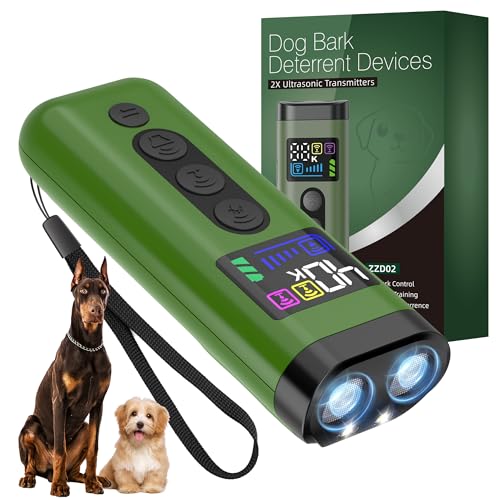
The Phzibor model extends range to 65 feet and uses three ultrasonic frequencies (25 kHz, 30 kHz, and 40 kHz) to accommodate different dog hearing profiles. It offers five training modes and features a color display for quick mode identification, making it a flexible option for varied environments. This device is positioned as a safe, humane alternative to bark collars, suitable for both indoor and outdoor use across yards, porches, and walkways. As with all ultrasonic devices, gradual training is recommended, starting at lower volumes and shorter sessions to monitor canine responses.
For optimal effectiveness, begin with minimal exposure and pair signals with clear verbal cues and positive reinforcement. Maintain a steady training schedule and ensure line of sight to the target dog. Be mindful of neighbors and other pets, and avoid aiming the device at non-target animals or people. The color display helps users quickly select modes during on-the-go training in parks or yards.
Buying Guide
Key purchase considerations help align a bark deterrent with your dog’s size, temperament, and environment. Range is important: larger yards benefit from longer reach, such as Phzibor’s 65 feet, while compact spaces may tolerate shorter distances. Frequency options matter for dogs that might habituate to a single tone; devices with multiple frequencies (like 25 kHz, 30 kHz, and 40 kHz) can reduce habituation and improve response rates. Training modes and the ability to switch between ultrasonic tones, beeps, or visual cues (LEDs or strobe lights) allow tailoring to each dog’s sensitivity and learning pace.
Weatherproofing and installation ease affect outdoor use. Look for IP ratings (like IP65) and mounting flexibility for fences or walls. Battery life and recharge options influence portability, especially for owners who walk dogs in neighborhoods or frequently train away from power outlets. Safety considerations are essential: ultrasonic cues should be used as a training aid, not a punishment. Some dogs, particularly those with epilepsy or other hearing sensitivities, may react poorly to ultrasonic stimuli; if signs of distress appear, discontinue use and consult a professional trainer or veterinarian.
Environment and lifestyle also guide the choice. If multiple dogs or neighboring pets are nearby, longer-range devices can help you address barking from a distance without mounting the device too close to other animals. For apartment living, a shorter-range model placed near the source of barking can be effective without disturbing neighbors. For households with nighttime activity, models with built-in LEDs or flash modes may aid safety during dusk and evening outdoor training. Overall, choose a model that combines humane training modes with a reliable signal that matches your yard size, home layout, and daily routines.
In practice, successful implementation depends on consistency and pairing ultrasonic cues with calm commands and positive reinforcement. Start with the lowest effective setting, observe how your dog responds over several days, and adjust gradually. Rotating modes helps prevent dogs from anticipating the signal. Always review guidance from the product manual and consider consulting a professional trainer if barking persists despite consistent, humane training efforts.